
Use Surface Conditioning Disc for Blending Surface Scratches on Stainless Steel
Abrasives-Sandpaper topic today is the use of surface conditioning discs and nylon hand pads to blend surface scratches on metal. We have outlined hand and machine processes and the abrasive products, power tools and abrasives commonly used in the blending of surface scratches.
Abrasives-Sandpaper blog is on location in a metal fabricating shop - blending surface scratches to create a uniform finish on stainless steel. To start – this is a Metabo angle grinder with a rubber back up pad 00059 and disc nut 00079 with the fine maroon hook and loop surface conditioning disc 33416. Hand finishing follows with the fine maroon hand pad 30059.
For deeper scratches several grits of nylon hand pads may be used in a step down process following the power tool blending with the surface-conditioning disc. This process can include the coarse tan hand pad 30080 then the medium gray hand pad 30074 and finally the fine maroon hand pad 30059.
View our line of hand pads and surface conditioning discs for the industrial abrasive products to best meet your specifications.
Click here – 6 x 9 hand pads – surface conditioning discs – to view the full product line.
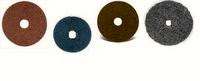
Stainless steel is a ferrous metal. Mechanically polished and brushed finishes are achieved with the use of abrasive materials. A wide range of finishes can be achieved depending upon the original grade of stainless steel as well as the type and texture of abrasive belts or abrasive discs used and the nature of the polishing technique. Stainless steel finishes range from a mirrored finish to a #4 brushed stainless finish to a satin finish. The most common finish used by appliance manufacturers is the #4 brushed stainless finish. Light surfaces scratches can be repaired to create a uniform finish on a brushed stainless steel appliance. Maroon and grey non-metallic hand pads can be used. You will want to use a block to create a uniform finish. Using your hand can cause streaking from the varied pressure of your fingers. It is very important to follow the direction of the grain in long even strokes in one direction only. If you “turn” at the ends you will create swirls.
These methods cannot be used on polished or mirror finished stainless steel or on stainless steel with a clearcoat finish also known as “smudge free”-“satina” or other names.
Remember – Always follow the grain on metals and know the surface you are working with!
Visit our webstore to view our full line of abrasives and industrial power tools. Our webstore is open 24/7 and we are available by phone M-F 8 - 5 EST at 1-800-888-1802
